Friday, July 1, 2011

Flightseeing Over Mt. McKinley


Flightseeing...A wonderful way to see the mountains a normal person would never see on foot.
Flightseeing- Taking a plane to the peaks of the Alaskan Range was such a eye-opening experience. The sky could not have been much clearer, the glacier much better to land on, the pilot much nicer, or the plane much smoother. But let's start at the beginning of my experience.

Each person filled out a form, basically a waiver, complete with how much each person weighs. If you lie the entire plane could be at risk so you must tell the truth. If you don't the guy will add at least 10 pounds to your weight. People are seated based on weight and couples often may not sit together. And yes, the form says you do not hold the company responsible if you DIE…I'm thinking that's not going to hold up in court if it is pilot error.


Next I was asked if I needed boots to cover my shoes for the glacier landing. Seeing that my tread was worn smooth I willingly accepted the NEO overboots, having never worn them in my life. I was amazed at the ease with which they went over my shoes, how lightweight they are, and how ugly they weren't! I WANT SOME!!! I was the only one on the flight to accept them and was very glad I did. Others expressed their dismay at not wearing them, as the glacier was quite slushy.

We were reminded to go to the restroom before boarding, because there would be no other chance for four and a half LONG hours. Most everyone thought that was a great idea…being mostly older people I'm sure you get my drift.

We were shown to our plane, placed in seats according to their seating chart, and told to buckle up.

We also put on headphones so we could hear the pilot's commentary throughout our flight. Those headphones kept our ears quite toasty and drowned out the engine noise. The safety lecture was given, location of sick bags explained, last words (not last rites!) were said, and we taxied for takeoff. We followed another plane down the landing strip and did a 180 turn in front of the first plane since two planes cannot sit side by side on these strips, nor can one pass another one. As soon as we turned around we flew down the runway and up we went. I am not a fan of takeoffs or landings but this guy did a pretty good job of both.


We passed over the small towns surrounded by the green hills and Nenana River snaking its way through the canyon. This canyon is a natural break in the Alaska Range. It did not take long for us to see the difference in the north side and the south side of the Alaska Range. The AK Range is 50 miles wide at Mt. McKinley. The moisture is mostly on the south side, because it originates from the Gulf of Alaska. As it goes over the range it warms up and dries up.

Mt. McKinley was named for Senator McKinley, soon to be President McKinley. Because he was a staunch supporter of the gold standard and gold was what brought many people to Alaska the powers that be deemed it fitting as a way to honor him. It is the highest peak in North America at 20,320 feet tall.

Now for the science of what I was seeing. The Pacific plate subducts the Northern plate, resulting in the Alaskan Range formation. These mountains are primarily sedimentary so they erode quite easily. The Denali Fault runs along the valley, appearing very similar to a meandering river. The Alaska Range has the highest rise in the world- 3,000 feet of rock and ice. Looking down upon all the snow and ice it is very difficult to determine height of these ice walls and snow banks, because there is no frame of reference such as trees.


This is a glacier tour so we expected to see many glaciers and we were not disappointed. There are major glaciers in this area, several of which are called circuit glaciers because they appear to be sitting in a cup-like formation. Muldrow and Trilicka Glaciers come from Mt. McKinley, Eldridge Glacier from Mt. Eldridge, and others are named Ruth, Peters, and Tahiltna. The dark areas in them are called moraines and can be lateral or medial. This is sediment which has collected as the glacier travels down from the mountain. Thousands of tons of sediment are transferred and the landscape is covered with very large boulders, ice chunks, and field debris, making it look like a river. The very black sediment is from the granite mountains.


As we flew closer to McKinley it appeared we would run into it and several of its shorter peaks. Of course we did not really come close to hitting anything, even though it looked so close we could have touched them. One area we flew through was a narrow spot between peaks so it was nicknamed "root canal". This is followed closely by "floss gap", "broken tooth" (a really jagged set of peaks), and "loose tooth". We wondered if they had been named by a dentist-explorer. Many of the peaks were named by the explorers, prospectors, and geologists who have visited, studied, and/or climbed these mighty mountains.

We also viewed upper ice faults whose ice was 1000 feet thick. Here's what they look like:


There are areas where cracks formed, water got into them, froze, and formed jagged edges. One such area is called Fang Mountains.There are also Eractics- ridges where glaciers melted and left valleys and sharp peaks.

On this day Mt. McKinley was in full view, her splendor out for all to see. It is said only 30% of Denali National Park's visitors actually see the mountain peak (We actually sell things in the gift shops which proclaim 30% Club on them). I'm guessing the count does not include the flightseeing tourists, because it is a given they will get a wonderful view of McKinley. At first I was actually surprised at the amount (depth) of snow on these mountains, however when you realize the temperatures go to the degrees below zero that is understandable. McKinley's peak temperature the day I flew was estimated to be around 20 degrees above zero.

Mt. McKinley and the associated peaks are actually one big rock! From 2,000 feet to 20,320 feet is a rise of over 18,000 feet. Mt. Everest, the world's tallest totally above ground mountain, has a rise of only 12,000 feet, so it looks like McKinley wins in that department. McKinley's base camp, #14 camp, and #17 camp were established by the National Park Service. They recommend that climbers wake up around 2:00 AM, go to the summit and back to Camp 17 in one day and spend only about 20 minutes on the actually peak itself. They do not use oxygen to climb this mountain. Most climbers call their friends and take loads of photographs before descending.

Lest people think this is a less dangerous one than Mt. Everest every season people die on this mountain. Only a week before my flight a man successfully summitted, returned to Camp 17, went to sleep and never woke up. So far at least five others have died and seven others needed rescuing. People cannot just go climb this mountain- a permit is required. 1700 permits are issued and no more than half, in any given year, make the summit. So more people successfully climb Mt. McKinley every year than have ever finished the Iditarod Sled Dog Race (That number is now at 595. Somehow you knew I would get around to talking sled dogs in here!).


Finally it was time for us to land on a glacier. Many flights are unable to land due to low clouds, rain, rough winds…snow too soft for a safe landing. Mine was flawless as we flew over those 1000 feet tall ice and snow walls. The landing was one of four planes this particular point in time and two others left soon after we landed. We were able to hang out on the glacier for about 25 minutes, walking only a short distance from the plane, (needed to stay out of the way of other planes coming in) and taking tons of photos. It is very difficult to see the screen because of the snow's glare (We were required to wear sunglasses and now it was obvious why) so we all hoped our photos would turn out okay. I had to make a snowball to see if it would hold together and it did not because it was too slushy. It made for a fun photo though. Soon it was time to takeoff so we all got back in the plane and had a smooth run in the slush. It was quite fun watching those ice walls get smaller and smaller.

Carl, our pilot and me


Our flight went in a different direction for some of the return flight. Most of the scenery was quite similar to what we saw coming up to Mt. McKinley. We did see Dall sheep on a very high mountain, as they like it up high since the bears do not like it that far up.

So many mountain peaks, so much snow, and beautiful blue sky the whole way…what a grand way to spend an afternoon.

Sunday, June 26, 2011

Chillin' in Fairbanks

My day off...what better to do than ride a train through the interior of Alaska? A few days before the day off I got a confirmation for the train, reserved a hotel room, and ordered my dinner. We ride in Holland America cars because they are the partners of the company I work for. Their cars are all domed cars so the views are wonderful from every seat. Employees dress up somewhat so I brought a skirt and oxford shirt. I was there in plenty of time because there are times employees get bumped for touring guests.

I boarded the train around four pm and settled myself in, as there were plenty of empty seats. I chose the very back, mainly because the rest of the car was a single tour group. I could also call people without being a distraction. I had at least three bars the whole trip, even in really desolate areas.

I took many photos, from the train's perspective, of the large hotels, the river, and the train. I only saw one moose eating, but I wasn't really looking for wildlife on this trip. I'll see plenty before I leave in July I'm sure. I did get many good sky/cloud photos.
The train car host was explaining about river silt, glacier melt, and assorted related science topics so I was taking notes which may be very helpful for my science classes this coming school year. I know people on the train probably thought I was nuts for snapping so many photos and taking notes about glaciers! We GOOD teachers never stop learning and collecting information!

Because our tickets are similar to standby meals are not included. I took a lunch from the hotel which was actually quite good. A banana and chocolate chip cookies rounded out the turkey sandwich meal. Several other couples came to the back where there is a small counter and laid out a cheese and crackers and wine spread. I talked with one lady from Australia who was just starting her month long vacation. She and her husband take at least one big trip every year, sometimes three or four. They are flying to Pruedoe Bay to go to the Arctic Ocean, then will spend time in most of the big cities as well as small villages. They are not going to Barrow, the northernmost town in North America. I found that a little odd since they will be in Alaska for so long, but they did not know the significance of it geographically. Plus, Barrow, on the first day of summer does not see the sun set at all. As revealed on time lapse photos the sun makes an arc in the sky just above the horizon. Seriously, look it up to view the photos.

Once we arrived at the Fairbanks train station there were five Holland America buses waiting to take their passengers to the Westmark hotel. Once the bus was full the driver reminded everyone of the safety briefing he had to give. Apparently, every time they got on a new source of transportation the driver, pilot, whoever, had to repeat their safety and emergency plan. By the time they were in Fairbanks that briefing was down to one sentence, "Find the emergency exit and get out!" I think by that time they had probably changed vehicles at least nine times in six days.

We arrived at the hotel and I had no competition at the desk to get my key because everyone already had theirs in an envelope. I was given a first floor room in a very quiet part of the hotel. I put everything down, changed into walking clothes and went out for my 10K volksmarch around Fairbanks. It was after nine pm by now and I think I finished those six miles by midnight. I went through a place called Pioneer Park that has homes from a longtime ago, an old
steam shovel, a fine arts center with colorful native masks on the outside of the building, and an old riverboat.


For those of you who do not know what a volksmarch is, it means "people's march" and it widely done in Europe. THere, people go in large groups to walk the countryside, generally on Saturday and Sunday. Participants get a start card and either mark or have punches made to show they have passed specific checkpoints. Sometimes there are trivia questions to write the answers for on the card. These prove you have actually made it to the halfway point. At the end beer, brats, and sweets are available for purchase. Generally in the USA there is none of that if you are doing a Year-round march, meaning you can walk it anytime you wish during the year.

On Thursday I got up early, well early for me! I planned to be busy today: go to Creamer's Field, visit the Large Animal Research Station (LARS) at the University of Alaska, Fairbanks; and go to the Yukon quest HQ to listen to Jodi Bailey. I bought an all day bus ticket for $3.00 (great deal by the way) and headed for the LARS first, mainly because it was the most remote of all the places I wanted to visit. I was able to take the bus most of the way, but wound up walking about 1 1/2 miles to get there.

LARS has funding from the National Science Foundation so their set up is quite well done. There are caribou, reindeer, and musk oxen. Who knows the difference in a caribou and a reindeer? Answer will appear somewhere is a future blog!)
There are large sections of land separated by fencing for each group of animals. To see the entire facility a tour guide must take visitor around. Today there were several elderly women who got to ride in the golf cart, mainly because their adult daughters told them they didn't need to be doing all that walking...You could see them rolling their eyes as they said this! The guide talked about the specific research topics being studied, mainly nutrition. Here's the nutrition for one young musk ox-

Next, I waked about another 2 1/2 miles to get to the closest bus stop for my Creamer's Field jaunt. The road the bus usually takes was closed for construction and I have no idea where to go, mainly because I figured all pedestrian traffic was detoured also. I called the bus company and finally, after talking to several people, was told to basically run to the next stop on the route and I'd make that next bus. I knew where that stop is so I got moving and barely made it to the bus before it took off. After a short ride I got off at Creamer's Field.


It is, in fact, a field with marshes set aside for birds to migrate to and have sanctuary or refuge. I really do not know what I thought I would see besides birds in a large field...that's exactly what I saw! There were lots of Canadian Geese hanging around, but not much else. It took me all of five minutes to watch them and decide I was done!

Unfortunately the next bus wasn't coming until 55 minutes later, so I figured I might as well walk. My thinking was I would probably get there faster than waiting for it. That was about another 3 1/2 miles so I really racked up the mileage in those two days! I went to the Yukon Quest Headquarters (another 1000 mile sled dog race I enjoy following) to listen to Jodi Bailey talk about her race and see her dogs.

Jodi made history this year by being the first musher to complete the Iditarod and the Yukon Quest as a rookie in the same year. YQ runs in February and Iditarod runs in March so there was not much time between her races and she was using some of the same dogs. She is so energetic and truly loves being with her dogs during training, on the trail, and hanging out in the summer. She brought three of them to show the public, who have serious misconceptions about sled dogs, mostly in part to movies who cast the wrong dogs for their canine roles.


She talked about their food, drop bags, their training schedules, how they are selected, what the YQ was like, and a few about the Iditarod also. She realized I was there and just asked me about prize money for Iditarod, which I thought was kind of cool, because I did in fact know the answer. She announced I was a teacher who follows sled dog races with my classes and to please excuse her for just a second. She came over, gave me a hug, and signed my Iditarod book. I figured now was the time to ask for some dog fur so she did a quick demonstration on how she grooms the dogs to get their winter coat of fur off and gave me what she had on the brush. I'm going to be using it for science class so she told me she would get some from the kids she left at home and would bring me some on Saturday. Now I have fur from Mike Santos, Jodi Bailey, the NPS dogs, and soon will have two more kennels' contributions. This is shaping up to be a great science lesson on comparing and contrasting, observation, and analysis of matter. No I am not insane, rather thinking out of the box (which I've never been in anyway). This will be my introductory set of lessons for sled dog racing so why not make it a real attention grabber?

Having done of this I went back to the hotel, collected my bag, got on another bus and heading to the gathering place of employees who were taking the hotel bus back to Denali. I did a little shopping in the grocery store, wrote in my journal for this blog while waiting for the bus, and talked to people. Around 6:15 pm the bus was ready to roll and we picked up others from the movies, and headed home. I might just make this trip to Fairbanks again- good night's sleep at a good hotel, great ride on the train, and I did enjoy all of the walking, as I have now earned my summer 100 mile club T-Shirt!

Saturday, June 18, 2011

Not All Sled Dogs Run Races...Denali National Park Kennel

I've been to two kennels where the owners raise and breed sled dogs and race their dogs. On Thursday I went to a different kind of working dog kennel which all America taxpayers contribute to when we pay federal taxes. This kennel is in Denali National Park and these dogs are used in the park to haul supplies, rescue visitors, and be an integral part in the construction of structures where no motorized vehicles may go inside the park.

The rangers here may put 800 miles on their sleds and dogs during a single season. These dogs were described as football players, compared to racing dogs who are marathon runners. They love to work and do what they can to please the rangers.

Because we pay for their training, upkeep, and medical costs the public should have access to them, so the park gives FREE demonstrations three times a day during the summer. Visitors meet at the Visitors' Center, by way of white dog paws painted on the ground, load park buses, and are driven to the kennel. Once a bus arrives people can go straight to the kennel to love on the dogs, pet them, or just photograph them.

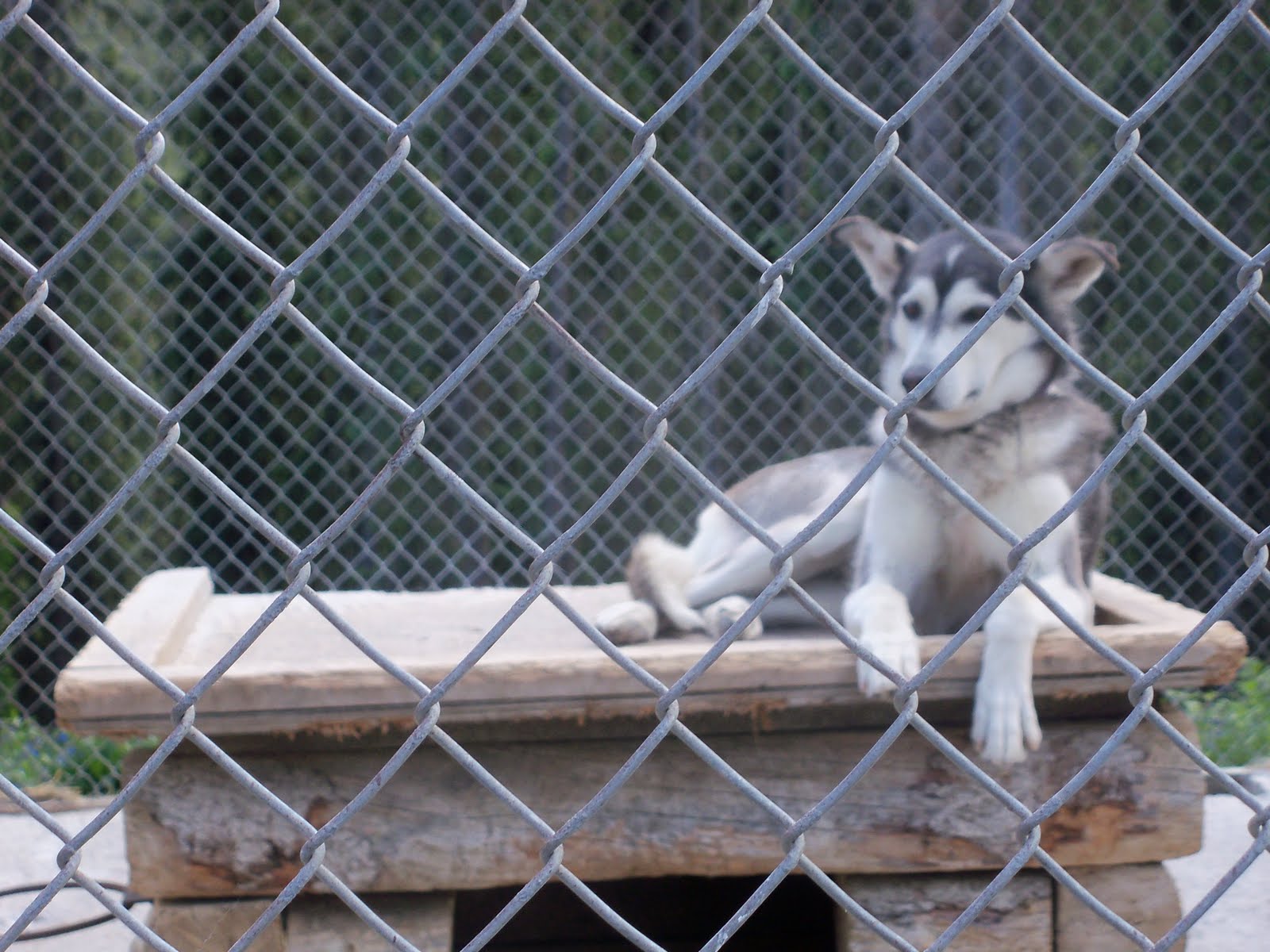
The dogs are housed in three ways. Some are penned up, but not because they are dangerous or even in trouble. Visitors may reach through the fence to rub these beautiful dogs. If the dogs don't feel like being touched at any given time they will go to their houses or at least get out of the reach of a human hand. During the summer these dogs need to sleep or at least rest during the day because it is just too hot for them.


Mixtus slept, Aurora sat politely, and Spur sat close to the fence so he/she could
receive affection.


The next type of setting is the roped off areas. Those dogs will walk up to the ropes and you can touch them politely or give a nice long back rub if they prefer those! visitors cannot walk over to the dog if it means crossing over the roped off area. Most of the dogs would come up and sit, as if to say, "OK, I'm ready for you to love on me..." When they were done they would either go sleep in, on, or around their houses.

Cassin was a very sweet dog but wanted to sleep.

I can't read this dog's name on his house, but he was very interested in everyone who walked to him or by him. Look at his beautiful stance!

Lava. He was more interested in looking important on his house! He even turned his back on me once, then looked around to see if I was still standing there.

The last type of housing were those dogs who had no pens or ropes. They were allowed to be approached if sitting or laying on their houses or just hanging out at their houses. Most of these guys were really fun to interact with, mainly because they had no barriers between them and us. Chultina gave me a big face lick so I reciprocated with a kiss on her face.

Nuna and Sultana were two other favorites of mine.


I got some of Sultana's fur to show my students. As with the dogs at Mike Santos' kennel, the dogs' fur here is given to, or sold to, a lady to make hats and headbands. Each day these dogs are brushed and the buckets fill up pretty quickly!

These dogs love anything that has to do with running. Because the temperatures are way too hot for them to take actual training runs or haul supplies they do a short demo run every few days. When they see it is time for a show they start barking, jumping up and down, trying to get the rangers to pick them. Poor Sultana...Ran on Wednesday so wasn't getting picked today. That did not stop him/her from wanting to go. At several times while others were being hooked up to the gangline this dog had all four feet off of the ground, jumping several feet up!
After a run the dogs get water and rest while the ranger continues to talk about them and their work, then answers audience questions. They still want the attention though...

When the dogs decide they are not interested in working any more they are eligible to be adopted. It is a very competitive application and only people from the northern part of the country can adopt them, due to the climate they need to live in. Huskies do NOT need to live in the south or southern midwest or even the areas where it gets really warm for part of the year. Recreational mushers understand a dog's need to have a purpose, so they may be used for small teams or skijoring. After about age nine apparently many dogs begin to actively search for ways to retire.

DNP also has positions for dog walkers during the summer. When the park closes volunteers come in and take a specific dog out for a walk. Lest you think it is easy, imagine handling one dog who, with a few others, can pull a sled filled with hundreds of pounds of supplies. Now imagine that dog on a leash, not pulling anything, except for maybe you! They do obey but it must be taught to them so they won't drag their walker clear down the path!


The last really important dog is Buck. He doesn't say much, eating is not a problem, nor is cleaning up his messes. Buck stands on his house all day, accepting handouts. He takes coins and dollar bills, anything to help support the kennel. All donations are thankfully received and the dogs benefit from generous donors.

So the next time you visit Denali National Park, you simply must give these dogs a visit. They are definitely a bright spot for most people who have been shuffled from ships to trains to buses, always on a tight schedule. Lucor would certainly appreciate aback rub or neck rub from you!